
Age-Friendly Environments (AFE) ECHO Programme – 4th Edition
The WHO Global Network for Age-friendly Cities and Communities (GNAFCC) was established in 2010 to connect cities, communities and organizations worldwide with the common vision of making their community a great place to grow older in. The mission of the Network is to stimulate and enable cities and communities around the world to become increasingly age-friendly.
Given the extensive experience of Network Affiliates and members, there is an opportunity for more experienced leaders to mentor those that are new to this work. Recognizing the invaluable benefits that Mentorship programmes provide, the WHO set up, with support from the International Federation on Ageing (IFA), the Age-friendly Environments Mentoring Programme (MENTOR-AFE) to help develop and strengthen skills and competencies of individuals through one-to-one mentor-mentee relationships.
The programme generated a high number of requests which could not be fully met through the mentor-mentee programme. To respond to the demand, WHO and IFA have developed another initiative under this programme: Age-Friendly Environments (AFE) ECHO – a multi-session learning cycle, developed and guided by the needs of mentee applicants and aligned with approaches and guidance from WHO on age-friendly cities and communities.
Registration Open Now!
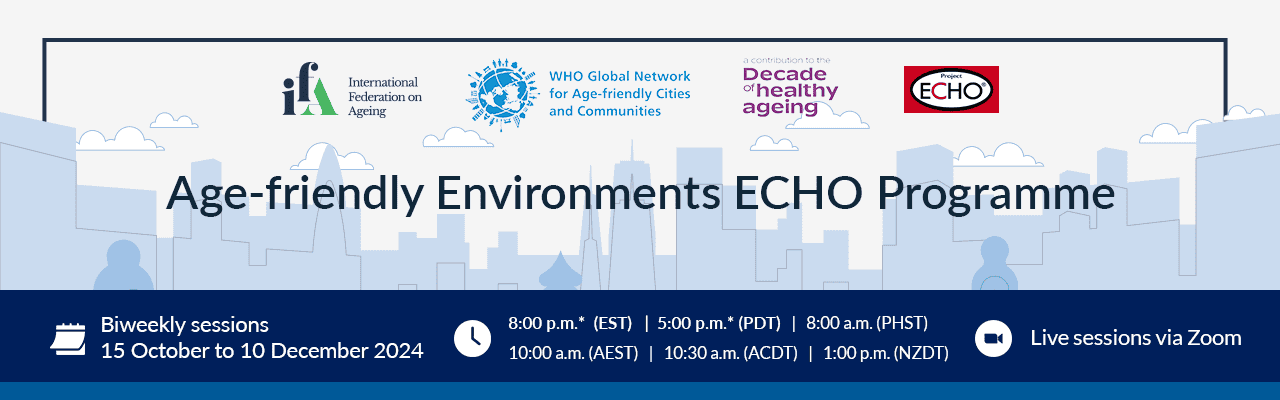
4th English Edition of the Age-Friendly Environments AFE ECHO Programme
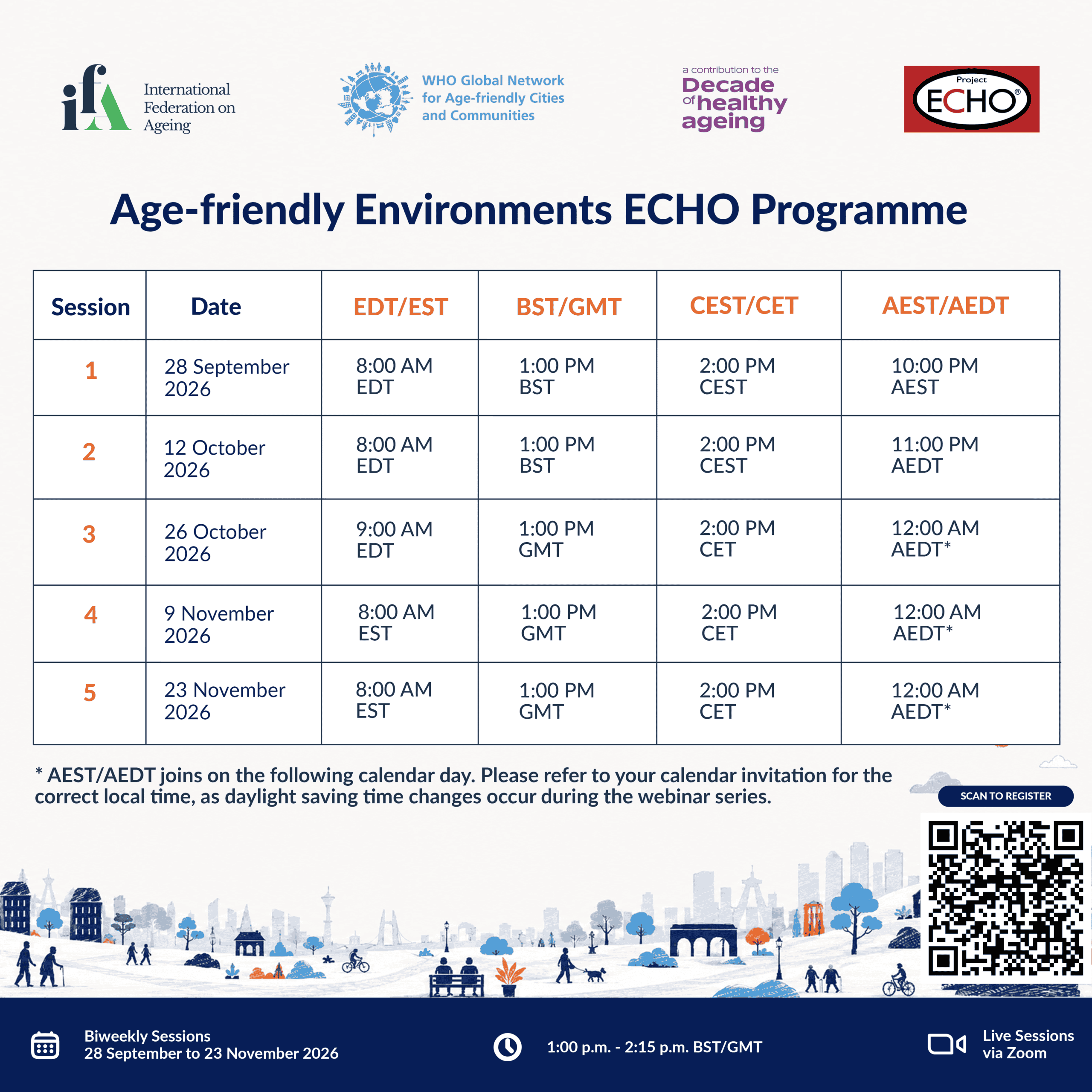
28 September to 23 November
On behalf of the World Health Organization (WHO) and the International Federation on Ageing (IFA) it is a pleasure to invite new and emerging leaders of age-friendly cities and communities from around the world to participate in an innovative and exciting learning opportunity: the fourth English edition of the Age-friendly Environments (AFE) ECHO Program hosted from 28 September to 23 November. Building on the momentum of previous editions, the AFE ECHO Programme 4th Edition provides a collaborative learning platform where participants can explore innovative approaches, discuss real-world challenges, and exchange solutions that support age-friendly communities.
Delivered with the support of Affiliates to the Global Network for Age-friendly Cities and Communities, the program will provide a safe environment where participants can share knowledge and learn from experts and other learners through collaborative problem-solving, to gain the skills necessary to advocate and drive the age-friendly model within their own city and/or community.
Through five sessions of case-based learning and global dialogue, the programme will examine strategies that advance healthy ageing, strengthen community engagement, and support the implementation of age-friendly policies and initiatives across diverse settings. Join colleagues from around the world to learn, connect, and contribute to building more inclusive, accessible, and age-friendly societies for current and future generations.
Schedule and Sessions
The Age-Friendly Journey: An Introduction
Globally populations are ageing and increasingly in towns and cities rather than rural and remote areas. The experience of older age and the opportunities it affords are strongly influenced by the physical and social environments in which we are born, live, play, work and age. By creating supportive and inclusive places with the right policies and services, communities can create environments that empower older people to be and do what they have reason to value.
Key principles for creating age-friendly cities and communities around the world include the participation of older people, equity, intersectoral collaboration, life-course approach and multilevel governance. These will all be explored in the first session.
Learning objectives:
Participants will be able to:
- Improve understanding of the importance of age-friendly environments in the context of a life-course approach to healthy ageing and in response to key megatrends – urbanization and demographic change
- Understand the history and key features of the WHO Age-friendly Communities Framework and programme cycle
- Understand what an age-friendly community can achieve.
Engage and Understand
The engage and understand phase is critical to the needs and experiences of older people and other communities’ members in order to gain political commitment and generate ownership among all stakeholders.
Knowing how to start this process, who to engage and what tools are available to support this process notably to do a context analysis and an age-friendly assessment are the subject of this session.
Learning objectives:
Participants will be able to:
- Describe mechanisms to build a network of stakeholders
- Describe steps to identify the needs of the older population
- Understand steps needed to analyze the challenges and opportunities in a community and define priorities for action
- Describe strategies used to influence and inform the political commitment for age-friendly initiatives
- Describe what successful engagement looks like and the anticipated outputs
Plan Strategically
Developing and implementing a comprehensive age-friendly strategy, that aligns with the needs and assets of older people requires local stakeholders across sectors to agree on a common vision, identify priorities, and develop a plan that leverages the strengths of various stakeholders.
How to create a shared vision and develop a strategy and action plan informed by the findings of the context analysis and age-friendly assessment and ongoing deliberations with stakeholders is the focus of this session.
Learning objectives:
Participants will be able to:
- Describe the purpose, process, and key success factors in delivering an age-friendly strategy and action plan.
- Describe the steps needed to develop a comprehensive strategic plan
- Understand the importance of defining common objectives, aims, targets and stakeholder responsibilities
- Identify strategies for securing support and resources;
Act and Implement
Taking action is at the heart of efforts to create an age-friendly city or community. After the assessment, consultation, and strategic planning stages, concrete actions need to be taken.
There are a large number of actions that can be taken to impact the lives of older people. Considering scientific evidence on effectiveness, estimates of costs of investment, stakeholders’ experiences of implementing similar interventions, outcomes and impact can inform the action plan. Action planning and coordinating different stakeholders, while keeping older people meaningly engaged in the process, are all key to bringing about transformative change are the focus of this session.
Learning objectives:
Participants will be able to:
- Understand the importance of consulting on the action plan and involving older people at all stages
- Describe the process for designing a successful action plan
- Understand the steps needed to implement an action plan; and scale up successful action
- Understand the importance of learning from successful action in local, national and international networks
Monitor and Evaluate Progress
The success and sustainability of an age-friendly action plan is measured by its ability to show achievements but also to evolve in response to local changes in context and needs. This depends on robust monitoring and evaluation.
Understanding whether a community has become more age-friendly (outcome and impact assessment) and how a community has become more age-friendly (process evaluation) can demonstrate the benefits of the actions but also help to sustain political commitment and ensure future funding for age-friendly initiatives.
Learning objectives:
Participants will be able to:
- Describe the steps needed to monitor processes continually
- Understand the principles needed to undertake both outcome and impact evaluations
- Describe strategies for sustaining and improving action informed by evidence
The Anatomy of an ECHO
AFE-ECHO participants are taken through the main components of the WHO age-friendly framework by global experts, towards building competencies to lead, influence, and implement the development of age-friendly environments. Each session will also create a space for participants to apply what they learn through collaborative problem-solving. AFE-ECHO creates a forum where participants learn from one another by refining and testing knowledge through local case studies, with a long-lasting impact far beyond that of a webinar or an e-learning course.
AFE-ECHO comprises five 1-hour sessions, taking place bi-weekly over a 3-month period, and are held in virtual format over Zoom. Following the standards of the ECHO model, participants are expected to attend all sessions, as the experience and knowledge are cumulative. Every AFE-ECHO learning cycle focuses on four key areas:
- Engage and Understand
- Plan Strategically
- Act and Implement
- Monitor and Evaluate Progress
The ECHO Model has been leveraged across many fields including education and social justice. There are more than 860 ECHO networks in 44 countries that have trained more than 148,000 learners from 30,000 organizations,
Project ECHO is a hub-and-spoke model which connects organizations (the “spokes”) with a group of experts (the “hub”). Drawing on a proven standard format and process for learning and building knowledge, during each AFE ECHO session a didactic lecture from a subject matter expert sets the specific context which is followed by a learner presenting a case to the other experts and learners for discussion and recommendations. Participants learn from one another as knowledge is tested and refined through a local lens.

Social Media Toolkit
Help extend the reach of the 4th Age-friendly Environments (AFE) ECHO Programme. A social media toolkit is available with ready-to-use resources to help you share the programme across your networks and connect more communities and partners with this global learning opportunity.
The Hub Team
Dr. Kathleen Brasher
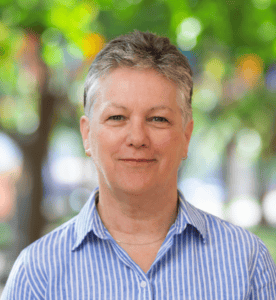
Dr. Kathleen Brasher, Research Fellow, John Richards Centre for Rural Ageing Research in the La Trobe Rural Health School.
Kathleen is research fellow at the John Richards Centre for Rural Ageing Research, La University.
Since 2006, Kathleen has been involved in the World Health Organization’s Age-Friendly Cities and Communities initiative undertaking the initial research in Melbourne and providing policy advice and training across Australia and internationally.
Her current research focusses on the implementation of a model of integrated care for older people in health services and with community members in small rural towns across northeast Victoria, Australia.
Natalie Turner

Natalie Turner, Deputy Director for Homes and Communities, Centre for Ageing Better
Natalie joined the Centre for Ageing Better in 2016. Her role is to help create more age-friendly homes and communities where people can live longer, healthier lives and keep doing the things that matter to them.
Her team works to improve the quality of existing homes as well as ensuring that new homes being built are accessible, affordable, suitable and desirable for older people to move to. As the UK affiliate of the World Health Organisation’s Global Network for Age-friendly Cities and Communities her team has spearheaded the growth and development of Age-friendly Communities across the UK since 2017.
Natalie has been working on ageing issues locally, nationally, and internationally since 2010. She was previously at AARP in Washington, DC translating international practice for a US audience, and also at Age UK London.
Charlotte Lewis

Charlotte Lewis, Head of Communities, Centre for Ageing Better
Charlotte manages the UK Network of Age-friendly Communities, a growing UK movement affiliated to the World Health Organisation.
The Network currently has a membership of over 100 places covering a population of around 30 million people. In her role Charlotte works to inspire, connect and support existing network members through leading the network learning programme.
She is also responsible for growing the network so that more places across the UK can become age-friendly. Charlotte joined the Centre for Ageing Better in September 2020 as part of the Innovation and Change team where she worked to develop innovation projects to ensure people are able to live healthy and active lives and be in fulfilling work as they age.
Dr. Suzanne Garon
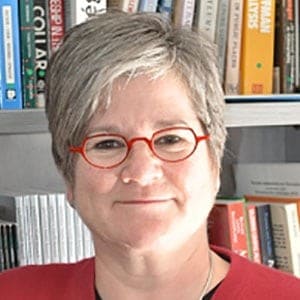
Dr. Suzanne Garon, Professor, University of Sherbrooke and IFA Board of Directors
Dr. Suzanne Garon is a full professor at the University of Sherbrooke’s School of Social Work. She teaches at the undergraduate, graduate, and post-graduate level, and she is responsible for the epistemology seminar in the Gerontology Ph.D. program.
Dr. Garon obtained her Ph.D. in sociology at the J-W. Goethe University Frankfurt in 1992. She is a specialist in program evaluation and a researcher at the Sherbrooke Geriatric Research Institute. Her research interests include community development, participatory evaluation methods, and social recognition of potentially excluded citizens, such as older adults. She is the author of numerous scientific articles and book chapters, and the co-author of several books on non-governmental organizations, social recognition, and senior participation.
Since 2006, Dr. Garon has been involved in the World Health Organization’s Age-friendly Cities and communities project. The model developed by her team has since been implemented in 900 cities in Quebec. She is the principal investigator in the implementation and evaluation of the Age-Friendly Cities and Communities program in Québec (AFCC-QC) and since 2017 the director of the World Health Organisation Collaborating Center on Age-Friendly Environments.
David McKinney

David McKinney, Ageing Well Lead, Older People's Commissioner for Wales
David works with individuals, organisations and communities at a local, regional and national level to support, inform and empower local people to develop innovative and practical ways to enable older people to age well.
He leads on the development, implementation and evaluation of local and regional events that support and empower people to have their say about what they would like to change in their community and identify the steps that they (and others) could take to help older people to age well in communities across Wales, alongside producing and promoting a range of tools, resources and practical guides to support change within communities across Wales.
Have Questions?
Feel welcome to contact the IFA’s Senior Policy and Project Coordinator Ms. Elizabeth Lewis (elewis@ifa.ngo) with any questions about the AFE ECHO Programme.